Wednesday, 9 April 2008

Everyone's Feeling the Pressure


Revision Hell It's that time of year again. The tension and pressure on us poor law students is so palpable you could almost reach out and grab hold of it. Yes, exams are looming, stretching ahead like a barren wasteland of doom, gloom, hard work, and sleepless night.  And by the time we're into May, sore-finger-itis sets in: our poor hands are left raw and cramping - a symptom of gripping pens too tightly and writing too much in too short a space of time. Revising becomes the number one objective and all of us get more than a little uptight, fraught and tetchy as the days of untold torture unravel. As our tempers get shorter and our patience evaporates, co-habiting with a revising law student can prove a living nightmare.


And let's face it: it's an awful time.  A time when we students can frequently be found in a semi-delirious state, chain smoking with strained, bloodshot eyes and tousled hair, slumped over textbooks and surrounded by reams of paper. And some people reckon that life as a law student is easy?!

So how are some of the ‘regulars’ bearing up?

Legal Lass admits to being 'in the revision zone' something we're all sadly well-accustomed with. At least she’s ‘in the zone’ though – more than some of us, I’m sure. She does, however, relish the opportunity of spending all day in her pyjamas.

Andro is feeling the exam-time squeeze and posted a picture of a bunny being bathed as an indication of her own expression after a gruelling exam. She's also finding the tedium of revising aspects of the Civil Procedure Rules a headache. I'm sure we can all sympathise with that.

ASP is still posting as frequently as ever it seems. He’s pushing out content 2 or 3 times a day on occasions and seems largely unperturbed by the impending exams. The guy’s just relentless in his posting.

Lacklustre Lawyer is not only struggling with an intense workload but seeking a burst of inspiration as to the career path he should choose. And boy, do I know what that’s like!

Susie Law School - (yes, who still doesn't like to Law Actually) second 'nudge nudge' of the year - is documenting the progress of her exams, LPC style. I stopped blogging about my experiences on the LPC long ago. It was bad enough living the experience without raking over the coals on Law Actually.

Law Girl has apparently gone to ground during this 'busy spell' for law students. Pretty sensible, if you ask me.

Minxy's posting frequency has dropped a little of late, a testament, no doubt to her gruelling workload and the pressing time of the year. As ever, though, the number of comments to her posts remains startlingly high!!

As for Law Actually - well, I'm hoping to keep my posting fairly frequent in the coming weeks. I eased off a little last year on both my blogs, although to be fair, Law Actually wasn't properly 'bedded in' at that point. But I abandoned F1 Central for the entire revision period. This year, it seems, I've more or less abandoned it full-stop.

Tuesday, 8 April 2008

The End of the Internet

The End of the Internet Alistair Croll over at Gigaom has been doing some doomsday prophesising about just how the internet might implode, explode or otherwise end.  Much of it is lighthearted scaremongering, but it's important not to forget just how fragile and potentially vulnerable the internet as a whole is to attack.

Some of my favourites:

“Massive physical infrastructure failure. If an accident involving a couple of cables in the Mediterranean can make the Internet unusable for hundreds of millions, imagine what an intentional attack could do.”

“Someone subverts the Domain Name Service. The Internet relies on DNS. But if someone broke — or worse, subverted — the fundamental way in which we find web sites, we wouldn’t trust URLs any more. Phishing would be easy. Own the DNS and you own the Internet.”

Perhaps best of all:

“The lawyers get involved. The Internet has been an experiment in free speech. That may be coming to an end. Unable to go after the sites themselves, lawyers go after the hosters and registrars. That’s how Swiss banking group Julius Baer took whistleblower Wikileaks off the air. And once there’s precedent, others are sure to follow. The recording industry is already wondering if it can go after carriers for enabling copyright infringement. This is the irony of Net Neutrality: When telcos start treating different bytes differently, they aren’t ‘common carriers’ and may be liable for what they transmit, including illegal content. So they’ll comply."

Good point. Damn those lawyers, eh?! Interfering busybodies that we are!

“Walled gardens: Many countries already restrict how the Internet is used. China’s firewall — which includes 30,000 people tasked with finding improper users...”

Geez, don’t even get me started!!

Sunday, 6 April 2008

Law Actually Hot Picks of the Week

Another Sunday, another batch of my hot picks. I’ve no idea whether this will become a regular thing or if it's something more of a ‘passing fancy’. As ever, the same rules apply: what follows is a selection of news stories that caught my eye from the last 7 days.

Carphone Talk TalkTalk Talk says ‘No No’ to BPI proposal

Charles Dunstone, CEO of Carphone Warehouse has vocalised in the last week his disapproval of the music industry’s proposal to hold ISP responsible for customers who download music illegally. He lambasted the idea, quoting his legal team who advised him that trying to hold an ISP responsible in this way is analogous with trying to “prosecute a bus company that takes a shoplifter the shops”.

Talk Talk is the first ISP to have responded to the recent proposals that seek to force ISPs to disconnect users who download songs illegally. Dunstone claimed that “consumers had a right to unfettered internet access” and “it’s not our job to control it”. Good call.

Google Docs 'Web-based applications are all well and good, but there's still no beating the desktop computer.'

I agree wholeheartedly agree with this. I’ve used a lot of web-based apps in my time and some can be handy if you’re on the road or using a public computer which doesn’t have the required program installed locally. Still, cloud computing is improving all the time and, I feel, the direction the computing world is heading in, long term. It’s just we’re not there yet. Not even close.

Bikini Lines Doctor asks “Where has all the pubic hair gone?”

Okay, stay with me on this one – the article I stumbled across on Digg actually discusses a serious issue. The article documents, inter alia, the findings of two people who find the glamour and beauty obsessed world that’s spreading to the pre-teen age bracket increasingly disturbing. In one case, Melanie Engle an aesthetician (don’t worry – I hadn’t heard of it either) describes that recently a mother brought her 8 year old daughter in to a beauty salon for an eyebrow wax specifying that she wanted them “arched like a supermodel’s”. Later that day, Engle “was directed to give her pint-size client a … bikini wax.” Further on in the article, a one Dr Hillman – who specialises in adolescent medicine – has found it increasingly difficult to rely on err, ‘growth’ as a diagnostic aid. “[N]ow, I need to ask girls, if it’s not there, ‘Do you wax? Do you shave?’ Because so many of them do.”

Max Mosley Max Mosley caught with his trousers down

I was shocked to learn of Mosley’s antics this week in which it was alleged he partook in a Nazi-style sex orgy with prostitutes. Mosley initially refused to comment and has since vehemently maintained there was no Nazi role-playing involved at all. Mosley is now suing the News of the World for breach of privacy claiming unlimited damages. As a long-term fanatic of F1, it’s only natural I took an interest. Mosley, a former barrister who specialised in intellectual property disputes has weathered several crises in his time as FIA president but none quite like this. Assuming that there were no Nazi-themes involved in his rather shady antics, I think Mosley does a great job as president and should remain in the role. That said, I sense this story has a long way still to go and it remains to be seen if he'll get that chance.

Facebook Dollars And finally, thanks to Andro for giving me the heads-up on this one: Michael Arrington over at Tech Crunch is suing Facebook for $25 million for allowing 3rd parties to use his image and Facebook content as ads without his express permission. I blogged last week about the issue of Facebook seeking to grant themselves the right to utilise the user content for ads that’s tucked neatly away in their terms and conditions and now this.

--UPDATE --  This story: April Fool or non April Fool?  When I initially heard about this I couldn't decide what it was.  Trawling the comments, I noticed, people weren't buying it as a true story.  Just to clarify, I still don't know and I don't really care either way: half the lawsuits in America seem to be lifted from the pages of a joke book, quite frankly, so what's one more?  Whether it's a straightforward gag, frivolous lawsuit or double-bluff, what does it matter?  Would I personally try sue Facebook for 25 million dollars?  You bet your ass I would. 

Saturday, 5 April 2008

Good Pirates

Good Piracy From Torrentfreak.com 24.03.08:

If you are downloading stuff you wouldn’t have bought in the first place, according to economist Karen Croxson, you are probably doing the company that created the product a big favor. You, Mr ‘Good’ Pirate, are telling your friends, adding to the media ‘buzz’ and driving up sales.

Many pirates say that they would never have bought much of the stuff they downloaded or copied. If you fall into this category, you might be a ‘good’ or ‘promotional’ pirate. Croxson says that piracy is only a threat to sales when people who originally intended to buy, didn’t, and pirated instead. The others - of which there a many, many millions - never intended to buy and these, says Croxson, cannot possibly harm the seller.

Croxson’s view on this type of piracy is one that I’ve long agreed with. While these good pirates are technically breaking the law, they cannot be said to participating in an act of ‘economic piracy’ – for want of a better term. In other words, while these people may be infringing someone’s intellectual property rights, they are not defrauding them from revenue. There can be little doubt that getting to the root of the problem is the most effective means of combating piracy. However, companies have often made an awful fist of going about it. The worldwide DRM debacle is a case in point.

As is frequently mentioned on so many of the TWiT podcasts I listen to, DRM only hurts the ‘good guys’ and does little if anything to deal with the root problem: the hardcore, mass market pirates. In the case of DRM, it only inconveniences or, at worst, screws over the people who have genuinely purchased the material and want to enjoy it on several devices. Content vendors though, are catching on; DRM is becoming more flexible in that regard and in some instances, disappearing all together. Just look at the Amazon music store in the US who realised that far from protecting profit margins, DRM is actually hurting them. It was time to get rid.

Croxson’s speech, essentially, just re-iterated several well-known facts: people often download content illegally they were never going to buy legitimately. Far from being universally bad for businesses, you can definitely make the argument that some forms of piracy actually help. A person may illegally download a couple of ‘taster tracks’ of an artist’s work and then go out and buy the whole album. In that sense, you could argue, that kind of piracy DRIVES sales. In the same way, good publicity spread via ‘word of mouth’ from someone who has downloaded material illegally may encourage others they mention it to, to go out and buy it.

Downloading material for free on the net or making an illegal copy of a friend’s movie, CD or program, etc. clearly can have a negative impact on businesses who sell creative content. Worse still, is the problem presented by the mass market pirates who, frankly, screw everyone over. But still, Croxson’s points are well worth pointing out. In the scurry to protect their intellectual property rights at all costs, many content owners lose sight of the broader issues involved and end up inadvertently hamstringing themselves.

Don’t get me wrong, I’m not in favour of piracy per se but this story reminds us that piracy issues are by no means black and white, good and bad – there’s a significant amount of grey in between. Maybe it’s time that creative content producers started recognising that and making good use of it.

Thursday, 3 April 2008

Trouble on Myspace? Dial 999

Social Networking VictimFrom Gizmodo.com 02.04.08 

Social networking sites like Facebook, Bebo and MySpace may soon have to carry a '999' emergency link to improve the safety of kids online.

In a 73-page draft of a report due to be published on Friday by Home Secretary, Jacqui Smith, the sites will have to carry ads for the emergency services so that kids can call if they feel they are being targeted by potential abusers.

Experts contributing to the report claimed that youngsters are at risk from 'sexual grooming' by paedophiles, bullying and online fraud.

I'm not quite sure how practical and effective this suggestion is, quite honestly but at least the Government are examining the problems poses by social networking for young web users.  Undoubtedly, they want to be seen to be doing something, but whatever the reason, this issue is too important to ignore. 

I can't help feeling that better education of the risks involved, coupled with technological advances to help filter or restrict some of the more dangerous elements of the sites would be a more effective way to go.  I mean, blocking the site completely is more of a sure-fire way of removing the danger, but, sadly, if a kid wants to do something which their parents have forbidden, they'll generally find a way of doing it.  After all, they could opt for something as quick and straightforward as using the site at a friend's house whose parents don't block access to the site.

Better education, awareness and guidance are crucial because the whole point about online grooming is that the kids rarely recognise they're in danger.  Sticking an online banner ad up saying 'Dial 999' is going to have little effect on this problem, surely?  Save, perhaps, for tripling the number of hoax emergency calls.

In related news, Ofcom have today reported that around half the children using the net in the UK have profiles on social networking sites, despite the policies those site have in place to discourage and prevent pre-teens signing up.  In a somewhat trite observation, Ofcom noted from their research that such users are not particularly concerned with such issues as online privacy.  Oh really?

Wednesday, 2 April 2008

The Internet - Upside Down

Wifi Piggybacking fun  
What would you do if you discovered your neighbours were piggybacking on your wi-fi connection?
 

- Secure it?

- Call the police?

- Pay them a visit with a baseball bat?

- All of the above?

Or, perhaps, mess with their minds?

Well, Peter Stevens from ex parrot chose this latter option. Determined not to let his impertinent neighbours get away with it, he split the network and let his neighbours carry on surfing at his expense on one half while he used the other. Then, the games really began. As well as redirecting his neighbours repeatedly to Kittenwar he "set iptables to forward everything to a transparent squid proxy running on port 80 on the machine. That machine runs squid with a trivial redirector that downloads images, uses mogrify to turn them upside down and serves them out of it's local webserver."
 
The result: random text and graphics appears upside down and back to front.  And, as if that wasn't enough, Stevens made an alternation to the code to produce a blur effect to the webpages that the pesky piggybackers were viewing.  You can almost imagine them, rubbing their eyes repeatedly and blinking several times, before turning to one another open-mouthed, wondering just what the hell was going on.

Great fun.

Tuesday, 1 April 2008

Google Custom Time

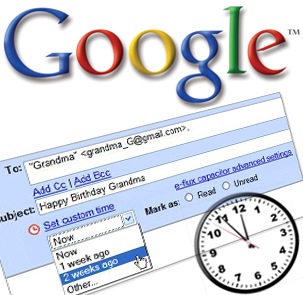
Google Custom Time In keeping with previous 'releases' by Google on 1st April each year, the internet monolith have this time rolled out a new feature to Gmail: Custom Time. This handy function allows users to send email so that it appears to have been sent hours, days, months or even years earlier than when the user actually clicked 'send'.

Here's how Google explain how to use it: "Just click "Set custom time" from the Compose view. Any email you send to the past appears in the proper chronological order in your recipient's inbox. You can opt for it to show up read or unread by selecting the appropriate option."

According to Google, there is an upper limit of pre-dating your mail back to 1st April 2004 - the date Gmail was released.

It certainly looks like a neat feature with a multitude of uses, as borne out by the 'testimonials':

"I just got two tickets to Radiohead by being the 'first' to respond to a co-worker's 'first-come, first-serve' email. Someone else had already won them, but I told everyone to check their inboxes again. Everyone sort of knows I used Custom Time on this one, but I'm denying it."
Robby S., Paralegal
 
"I used to be an honest person; but now I don't have to be. It's just so much easier this way. I've gained a lot of productivity by not having to think about doing the 'right' thing."
Todd J., Investment Banker

"This feature allows people to manipulate and mislead people with falsified time data. Time is a sacred truth that should never be tampered with."
Michael L., Epistemology Professor

And perhaps best of all: "The entire concept of 'late' no longer exists for me. That's pretty cool. Thanks Gmail!"
Miriam S., Delivery girl

Pretty neat, eh?

You only get 10 emails per year which can be 'pre dated', though. Google's explanation:

Our researchers have concluded that allowing each person more than ten pre-dated emails per year would cause people to lose faith in the accuracy of time, thus rendering the feature useless.


And the technology behind this wonderful new function in Gmail?

Gmail utilizes an e-flux capacitor to resolve issues of causality.

Love it. Almost as good as their
'TiSP flush drive' last year. If the idea of wired broadband where you flush cables down your toilet to establish a connection wasn't wacky enough, an email-time-machine more or less nails it.