Friday, 29 February 2008

Keep your privates, private, says Italian court

Crotch groper From the Guardian 27.02.08: 

In a landmark judgement with far-reaching social implications, Italy's highest appeals court has ruled it is a criminal offence for Italian men to touch their genitals in public.

..[t]he ban did not just apply to brazen crotch-scratching, but also to what might be termed superstitious pre-emption. Anyone who has seen a hearse go past in Italy, or been part of a discussion in which some terrible illness or disaster is mentioned, will know it is traditional for men to ward off bad luck with a quick grab at what are delicately called their "attributi".

The court was ruling on the appeal of an unnamed 42-year-old workman from Como near Milan. In May 2006, he was convicted of indecent behaviour for "ostentatiously touching his genitals through his clothing". His lawyer said it was merely a "compulsive, involuntarily movement, probably to adjust his overalls".

The workman was ordered to pay a €200 fine and €1000 costs.

Oh Boy.  I can't help but feel slightly uneasy over this decision. I don't know the full case facts, admittedly, in particular exactly how ostentatious his gential touching was meant to be.  But what if he really WAS just adjusting his overalls?  Or trying to get his car keys out of his trouser pocket?  Anyone who's ever donned on a pair of overalls will vouch for the fact that have two layers on is never easy and adjustment is sometimes called for.  But the case does raise a good question: when does an innocent scratch, surreptitiously done become a indecent, criminal touching? 

Thursday, 28 February 2008

Facebook privacy update

Facebook Update From Outlaw.com 21.02.08 

Social networking website Facebook claims to have fixed the privacy problems that have dogged it in recent weeks.

Users reported that it was impossible to delete all their information from the site, but Facebook says that total deletion is now possible.

There was an outcry when users discovered that they could leave Facebook, but that their details would remain on Facebook servers. The company said that this is in case users changed their minds and wanted to reactivate accounts.

Facebook, though, now says that it has introduced a method by which a user can permanently delete all of their information.

Let’s hope this represents a small step in the right direction but being unable to fully delete an account is a situation that should never have happened in the first place. The way people are using Facebook as a portal to throw up a plethora of personal information is nonetheless worrying. And there are so many doing so without stopping to think of the trail or ‘electronic footprint’ they are leaving behind, let alone giving thought to the repercussions. There should at least be more conspicuous warnings displayed on Facebook about the dangers of including personal details on the site. And while they’re at it, how about better access to the controls which users can adjust to limit others’ access to their personal details? While Facebook can’t be held responsible for people’s stupidity they surely owe a duty to highlight the dangers of their users’ actions.

In the computer room yesterday, I overheard a conversation which perfectly illustrated one of the main reasons why I despise Facebook.

"I've got 62 requests and they're all just....... nothing!” Oh great. Well worth visiting then and spending hours on the site. But it was still the first site she went to. I really give up with this one – I just don’t get Facebook’s mystical appeal.

But wait, there was more. She soon piped up with another belter: “oh and my friend joined the group that my cousin joined and that I joined and...”.  Yeah, whatever.  Let me guess, they’re all just..... nothing, right? A blatant waste of time and effort, building virtual cliques that are as desultory as they are irritating. And that's one of my biggest gripes about Facebook.  It's just aimless congregating of people, albeit in the online world. Not much better, though, than kids on street corners.

Wednesday, 27 February 2008

Security Toilet-Cameras

Security camera toilets From Mark Frauenfelder on Boing Boing, 26.02.08

Students at Lipson School in Plymouth UK returned from a one-week break to discover closed-circuit security cameras in the lavatories (They were "the round ones that can move," said one 15-year-old who saw them). After hundreds of students protested, the school agreed to remove the cameras.

I'm not sure I believe principal Steve Baker when he says he didn't know about the cameras, but if he's telling the truth, he should either fire the creep who ordered them to be installed, or he should resign in shame for not knowing what's going on in the school he is paid to oversee. However, Baker says he's not going to even discipline the unnamed miscreant who had the cameras installed. "It's a learning situation, not a disciplinary one," Baker said.

Principal Steve Baker said contractors fitted them on the orders of another staff member, who did not have the measure approved by him or school governors.

Mr Baker added that the system had now been disabled and would be removed as soon as possible.

He said: "Someone made an error. They had no authorisation from me or from the governors to install these cameras"

What the hell’s up with this? I seriously thought it was a joke when I first read it and I’m staggered that this hasn’t hit the news in a bigger way yet. I initially came across this on Boing Boing yesterday and traced it back to the source article, from the Daily Mail of all places. Well, there’s no accounting for taste.

But seriously? Tell me this is just an early April Fools’. Some random staff member saw fit to have security cameras installed in the pupils’ toilets and the school and contractors didn’t question it but rather looked the other way. The cameras, apparently, were installed as part of an ongoing surveillance system. But surveying what, that’s the question?

I’m gobsmacked over this, quite frankly. And that doesn’t happen very often.

Monday, 25 February 2008

'Plane' silliness: a double-bill

Take OffFrom The Times 25.02.08:

A British pilot has been dismissed for "buzzing" a control tower in a Top Gun-style stunt during the maiden flight of a Boeing jumbo jet.

Captain Ian Wilkinson astonished passengers by taking the 230-tonne Cathay Pacific jet to within 28ft (8.5m) of the ground shortly after take-off from Boeing's US manufacturing plant.

The 322mph fly-by was cheered by onlookers, and the pilot, who is said to be one of the most senior aviators with the airline, later toasted the flight with champagne.

Despite Captain Wilkinson being described as 'chummy' with the airline's top execs, he was foiled by captured video footage of his antics which was then posted on the internet.  It's suggested that in the circumstances, the airline would have turned a blind eye and attributed his showboating to being caught up in the excitement of the event.  Once the Hong Kong authorities got hold of that footage, of course, his career was as good as over.  Up until that point he was enjoying a £250,000 per year salary.  Shame.

From The Times 25.02.08:

Heathrow Airport was today investigating what appeared to be a serious security breach after four Greenpeace scaled an aircraft which had just landed after a domestic flight.

Greenpeace say that the protesters, two male and two female, climbed on top of the fuselage at 9.45am and mounted the roof of a British Airways Boeing 777 flight in Europe's busiest airport.

Police were this morning surrounding the aircraft. Greenpeace claimed that their demonstration, which the group described as an "incredible security breach", was ongoing.

What is it with Boeing 777s at Heathrow recently?  You’ve got to hand it to Greenpeace for perseverance at least, though.  After all, it’s not as though there are many options left open to them for new and outrageously thrilling ways in which to conduct their protests nowadays. The days of shocking us into sudden enlightenment as to the errors of our planet-destroying ways by leaping aboard foreign whaling vessels and the like are long gone, I fear.  We've seen it all before, Greenpeace, we really have.  Worthy, though their cause is, most people seem to have little time for them or their tactics. A bit tragic, really: despite frequently trying to justify their extreme and cavalier approach to protesting as being the only way to successfully make their point, it does them few favours in winning the public’s support.

It’s been said that the protest caused virtually zero disruption to travellers at Heathrow today, and the protesters did, bless ‘em, have the decency to wait until the passengers had disembarked before leaping aboard and raising their trusty banners. I’m just relieved they didn’t try and attempt a flyby to, you know, drive their message home.

Thursday, 21 February 2008

Facebook - You’ll Never Leave

Facebook Evil I just don’t ‘get’ Facebook, Myspace, Bebo and the other long list of candidates for the award of  ‘biggest online waste of space’. I never have understood the appeal and I never will. In fact, they drive me crazy as do the people who flock to those sites at every spare minute of their day. I have remained deliberately detached from such social networking sites and firm in my conviction to resist countless invitations and suggestions that I join up. Even if I wanted to – which I don’t – I couldn’t join now, anyway, through mere principle.

Anyway, given my palpable disgust of Facebook I was delighted to see that its popularity has dropped for the first time in 17 months on the Telegraph’s website:

But it still has 8.5 million users, making it the most visited social networking site in the UK, according to Neilsen Online, the internet research company.

MySpace also attracted 5 per cent fewer users in the period [December 2007-January 2008], from 5.3 million to 5.1 million, while Bebo came third with an audience of 4.1 million.

Nic Howell, the deputy editor of internet industry trade magazine New Media Age, said the figures indicated that Facebook’s popularity was in decline.

“This fall is a significant moment in the development of Facebook and potentially marks the high water mark of the site’s popularity in the UK.”

So although the novelty seems to be truly wearing off, I’m still gobsmacked by how long it’s lasted.

But it’s not just a case of me just choosing to be prudishly obtuse over these sites; there are real privacy concerns here. I’ve read many a lot of stuff recently relating to the difficulty people have experienced when trying to quit Facebook for good. For instance, the New York Times’ article on February 11th: How Sticky Is Membership on Facebook? Just Try Breaking Free:

“It’s like the Hotel California,” said Nipon Das, 34, a director at a biotechnology consulting firm in Manhattan, who tried unsuccessfully to delete his account this fall. “You can check out any time you like, but you can never leave.

And that’s just the tip of the privacy iceberg. Don’t even get me started about the flagrant disregard for online anonymity, with users being readily searchable and contactable by all and sundry registered with Facebook themselves. Those registrations, of course, could be under a pseudonym, by people using the site as a rich data base for fraudulent or sinister purposes. Factor into that the potential for online grooming and you’ve got a very dark side of the Facebook moon. I hate it.

I hope the world wakes up and smells the proverbial soon. Maybe then they’ll suddenly question what exactly all the fuss was about. ‘Pokes’ for instance - what’s the deal there?!? Seriously? It’s a just a website - get over it.

Wednesday, 20 February 2008

Parents' powers to check on paedos

Paedophile Picture From: The Times 18.02.08

A watered-down form of "Megan's law" is to be trialled in four police areas, giving parents the power to check with police whether people given regular unsupervised access to their children have convictions for paedophile offences.

Single mothers will be able to ask police whether potential boyfriends have child sex convictions before they start a relationship. Family members or neighbours who regularly look after children could also be checked.

Police and probation services will have discretion on what information is revealed in each case and disclosure will be carefully controlled. But it is understood that if children are thought to be at risk, parents and carers will be told.

Despite feeling that the whole ‘Megan’s Law’ idea relied on an over-simplification of the complex situations involved, I suppose that a trial like the one proposed is the best way to sample such an idea. It’ll be interesting to see how it fares and whether widespread adoption is a feasible option, without inciting mass public panic, a culture of obsessive checking and paranoia plus a repeat of the ‘naming and shaming’ debacles of a few years back. Going forwards too, I suppose, it’ll be another test to add to the growing list for determining the suitability of new partners. 

Tuesday, 19 February 2008

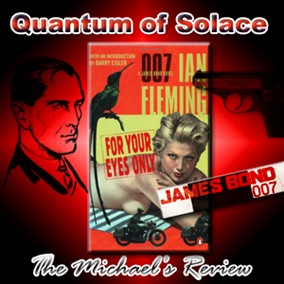
Quantum of Solace - the review

Quantum of Solace (red)

Once I’d heard that the recently announced 22nd Bond film was to adopt this title, I knew Ian Fleming’s short story would shoot to the top of my ‘to read list’. And so it did. I knew nothing of the plot or nature of the story, save for the fact it was a short novelette and inhabited the less popular end of the Bond-works collection.

Quantum of Solace is one of five short stories contained within ‘For your eyes only’. Taken as a whole, the anthology might be seen as a disjointed affair; each story stands almost entirely distinct from every other and the quality at times can feel a little patchy. Still, there’s no doubt that this compilation remains a fertile hotbed for Bond plot ideas.

While these short, unrounded and imbalanced Bond tales are far from being fully developed novels, they are by no means entirely abortive either. Each story stands as a microcosmic Bond tale but the trademark 007 ingredients are all there: death, good living, beautiful girls, exotic locations and intense emotions – you get the idea. If the idea of fast-tracked Bond action appeals – 007 thrust into new, dangerous and exotic scenarios without any superfluous padding – you’ll find rich pickings here.

Fleming was a talented and diverse writer. He had a tendency to experiment, to purposefully and deliberately leave his comfort zone and branch out into new genres or transcend an established formula. After all, Chitty Chitty Bang Bang stands a million miles apart from the hard-edged Bond novels. Adopting a female persona for ‘the spy who loved me’ is another case in point.

So what of the plot in Quantum of Solace? Bond has been asked to a dinner party in Nassau – a place he largely dislikes along with its inhabitants. The dinner party is no exception; he is surrounded by dull, gossipy middle-aged folk with whom he struggles to relate to. Bored with the futility of the idle and desultory dinner conversation, having been especially jaded by a rich Canadian and his wife - the Harvey Millers - he flippantly makes a throwaway remark about marrying an air stewardess, should he ever feel inclined to tie the knot.

Later, the guests disperse for coffee and liqueurs. With Bond trapped awkwardly into making small talk with the Governor of Nassau on a sofa with disconcertingly deep soft cushions – an apparent pet hate of Bond’s - his previous remark is revisited. The Governor proceeds to tell Bond a fascinating story from his earlier experiences in the civil service – about a socially and romantically inept colleague who fell desperately in love and hastily married an air stewardess. The tale is a tragic and surprising one.

The protagonist, Phillip Masters led a quiet, unvaried and lonely upbringing. He was emotionally undernourished in every sense. His first post in Nigeria exposed him to the most natural and effective interaction that he was to ever have with people – a fact made all the more tragic by his eventual return there. During a period of leave before starting his second secondment, he flew aboard an aircraft for the first time in his life and also met, sexy Welsh air stewardess, Rhoda Llewellyn. Within no time at all they had married and were living out in Bermuda were Masters was posted. Rhoda, presumably attracted by the quasi-excitement of her husband’s job was content and happy for the first few months. Masters, of course, was absolutely besotted from day one and couldn’t do enough to please his bride. But the happy days weren’t to last. She quickly tired of the area, and grew sick of the boredom and loneliness that pervaded her new life. It wasn't long before these feelings of discontent escalated to resentment and extended to the islanders around her and ultimately, even her husband. Having tried every trick under the sun to keep his wife occupied and content, he eventually wound up getting her a golf club membership. Shortly thereafter she met a rich playboy, Tattersall, and cruelly embarked on an open and sordid affair.

That was the last time he cheered for many a long day, perhaps for all his life. Almost at once she started 'going' with young Tattersall, and once started she went like the wind. And believe me, Mr. Bond" the Governor closed a fist and brought it softly down on the edge of the drinks table -"it was ghastly to see. She didn't make the smallest attempt to soften the blow or hide the affair in any way. She just took young Tattersall and hit Masters in the face with him, and went on hitting.

Masters fell to pieces and even attempted suicide. The Governor had tried a last ditch attempt to save him by posting him to Washington on assignment. While he was away, the affair died its death when Tattersall grew tired of Rhoda. Unperturbed in the prospect of winning her husband back and patching relations up with the locals, Rhoda knew how to manipulate people and situations to her advantage and do it well.

Masters, though, returned a changed man.

The Governor paused and looked reflectively over at Bond. He said: "You're not married, but I think it's the same with all relationships between a man and a woman. They can survive anything so long as some kind of basic humanity exists between the two people. When all kindness has gone, when one person obviously and sincerely doesn't care if the other is alive or dead, then it's just no good. That particular insult to the ego — worse, to the instinct of self‐preservation -can never be forgiven. I've noticed this in hundreds of marriages. I've seen flagrant infidelities patched up, I've seen crimes and even murder forgiven by the other party, let alone bankruptcy and every other form of social crime. Incurable disease, blindness, disaster — all these can be overcome. But never the death of common humanity in one of the partners. I've thought about this and I've invented a rather high‐sounding title for this basic factor in human relations. I have called it the Law of the Quantum of Solace."

Quantum of Solace — the amount of comfort. Yes, I suppose you could say that all love and friendship is based in the end on that. Human beings are very insecure. When the other person not only makes you feel insecure but actually seems to want to destroy you, it's obviously the end. The Quantum of Solace stands at zero. You've got to get away to save yourself.

And Masters did just that, or tried at least. He set out to destroy Rhoda in the only way he could: through silence and frigidity and a total denial of emotional contact for the remaining time in Bermuda.  A divorce was arranged for the when Masters’ secondment was to end but in the meantime, they kept up the facade of a happily married couple. He segregated their house, forbade her from certain rooms and while alone together, denied her existence entirely, save for requiring dinner at 8.00 each evening. And so it continued for a year. Shortly before that time was up, Rhoda set up an ‘appointment’ to see her husband. Having pleaded her case that she would soon be destitute, Masters made one compassionate concession and gifted the car and gramophone to his wife. Days later he left and the two were to never meet again. Rhoda tried to cash-in both assets, only to discover she had been tricked. Both the car and the gramophone had been bought on hire purchase and Masters was badly behind on the payments. Rhoda was destroyed.

After a several rough months during which Rhoda was forced to sell her soul as well as her body, a well-connected friend invited her to take up a job in a Canadian hotel. She fell on her feet and eventually married a hotel magnate and the two remained happily married and content ever since. Of course, the Governor lets slip at the end of the evening the identity of the parties.

Life's a devious business. Perhaps, for all the harm she'd done to Masters, Fate decided that she had paid back enough. Perhaps Masters's father and mother were the true guilty people. They turned Masters into an accident‐prone man. Inevitably he was involved in the emotional crash that was due to him and that they had conditioned him for. Fate had chosen Rhoda for its instrument. Now Fate reimbursed her for her services. Difficult to judge these things. Anyway, she made her Canadian very happy. I thought they both seemed happy tonight."

Bond laughed. Suddenly the violent dramatics of his own life seemed very hollow.

The story itself was gripping Fleming; the hard-hitting page-turning qualities that I’ve grown to love. Fleming had a clear point to make in the story. He wanted to explore relationships, notably those between husbands and wives – particularly when pushed to the limit or operating under a thundercloud of tension. When that final requisite element of humanity between two people disappears – when the relationship drops below the Quantum of Solace – the game is up. He looks at the interaction of jealously and inadequacy, coupled with feelings of entrapment, suffocation and boredom and how they can all play their part in the downward spiral of a relationship.

To some, it might present a grave, and uninviting tale. The Law of the Quantum of Solace is, after all, not concerned with the construction of something positive through love and marriage but rather the way a couple can tear apart each other through the same unity. Destruction and negativity is revealed as the flip side of the sanctity of marriage. An idea, perhaps, on which Fleming has many thoughts and much to say. (I previously picked up on a sagacious Fleming-ism in ‘Diamonds are Forever’:

James Bond: “Most marriages don’t add two people together. They subtract one from the other.”
Tiffany Case: “Maybe there’s something in that. But it depends what you want to add up to. Something human or something inhuman. You can’t be complete by yourself.”

Still, as a story it has much to offer and seeks to impart many wisdoms, cutting through the shrouds and obfuscation of complex relationship dynamics. In addition, the tale serves as a reality-check providing a healthy dose of perspective: how the carnage of a tumultuous relationship can prove every bit as destructive, evil and malevolent as the life and work of a paid assassin.  The importance of not judging a book by its cover is also brought strikingly to the fore, as Bond himself readily admits at the story’s end.

Quantum of Solace stands as a scrutiny of human behaviour, a tale that cuts right to the bone, examining inescapable truths through an uncomfortable aphorism. You won’t find classic Bond action scenes nor many of the other qualities that make up a typical Bond novel, but Fleming’s mastery for story telling more than makes up. It’s a fascinating, thought-provoking tale that I literally could not put down from beginning to end. Once a couple of pages in, the trademark Fleming brilliance for story telling becomes unmistakable and turns an unpromising opening scene in to a thrilling page-turner. Highly recommended.Star Review Bar small 4
